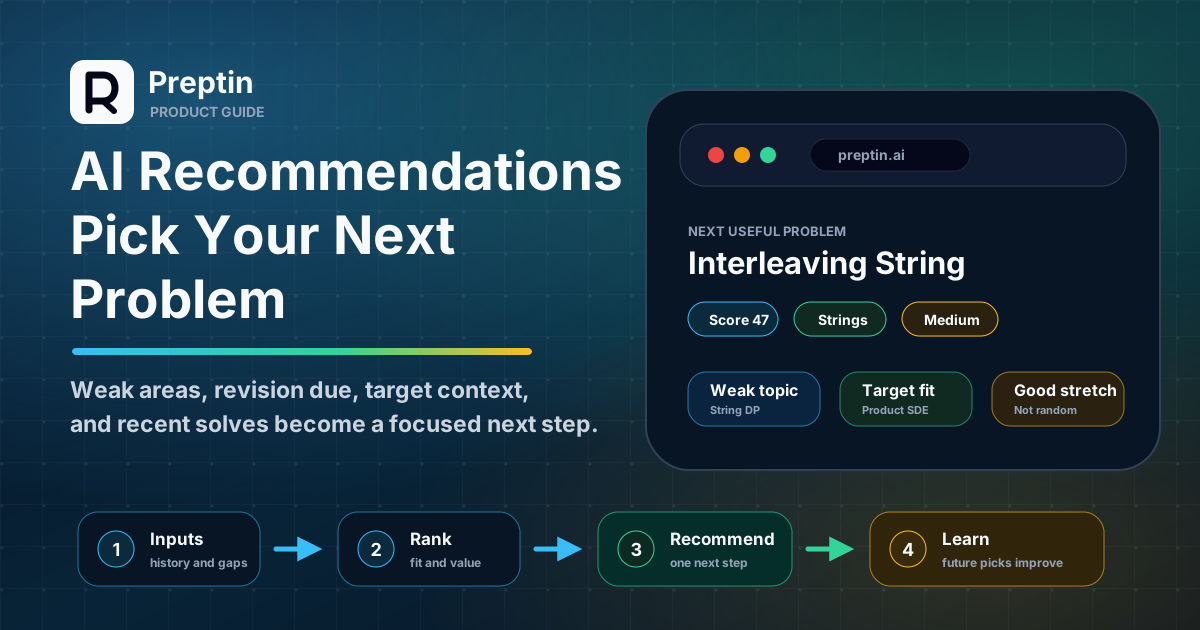
The hardest part of a prep session is often not solving.
It is choosing what to solve.
You open a problem list. There are hundreds of options. Some are too easy. Some are too hard. Some look familiar. Some belong to a sheet you started three weeks ago. Some match your target company. Some probably matter, but you are not sure which one matters today.
That is the moment recommendations are meant to help.
Preptin's AI recommendations are designed to answer one practical question:
What is the next useful problem for your current prep state?
Not the most famous problem. Not always the hardest problem. Not a random problem from a large list. A useful next step should have a reason: it should connect to your goals, your weak areas, your recent solves, your revision needs, and the kind of interview you are preparing for.
This guide explains how Preptin thinks about recommendations, what inputs influence them, and how to use them without giving up your own judgment.
The Short Version
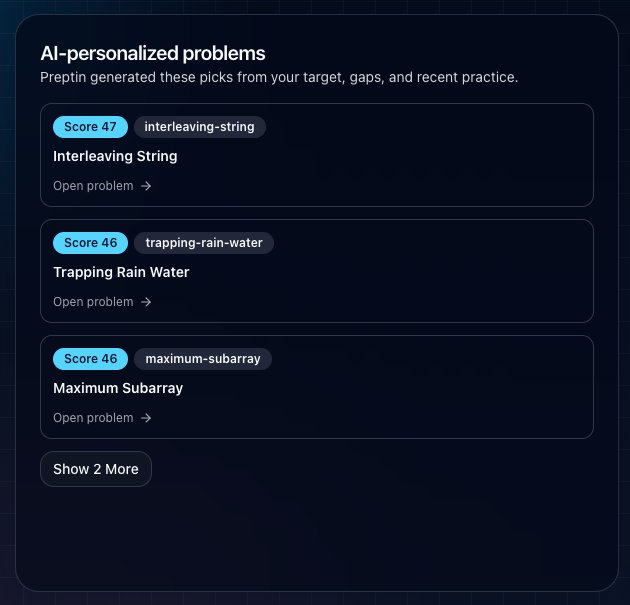
Preptin recommendations work by ranking candidate problems against your current prep context.
In plain English, the system asks:
- Does this problem match your target role, company, or preparation goal?
- Does it touch a weak topic or weak concept?
- Is it likely to teach something useful right now?
- Is the difficulty reasonable for your current readiness?
- Is there a revision benefit?
- Does it fit the kind of session you are likely to do?
- Have you solved or seen it too recently?
- Is it a strong interview-relevant problem?
Then Preptin surfaces the highest-value next picks.
The goal is not to remove decision-making completely. The goal is to reduce the blank-page feeling before practice starts.
Why Recommendations Exist
Most candidates do not suffer from a lack of problems.
They suffer from too many possible problems and too little context.
Without guidance, daily prep can turn into one of these patterns:
- Solving whatever appears first in a list.
- Repeating comfortable topics because they feel good.
- Jumping to hard problems too early.
- Ignoring revision because new problems feel more productive.
- Following a sheet mechanically even when today's weak area is elsewhere.
- Solving company-tagged problems without knowing whether they match your actual gaps.
None of these are always wrong. A sheet can be useful. A hard problem can be useful. A familiar topic can be useful.
The issue is that "useful" changes with your state.
If you have not touched graphs in two weeks, a graph problem may matter more than another array warmup. If you keep missing binary-search boundaries, a medium binary-search problem may be better than a random hard dynamic-programming problem. If you are preparing for a target company, company relevance may matter more than generic popularity.
Recommendations exist to read those inputs together.
What Makes a Recommendation Different From a List
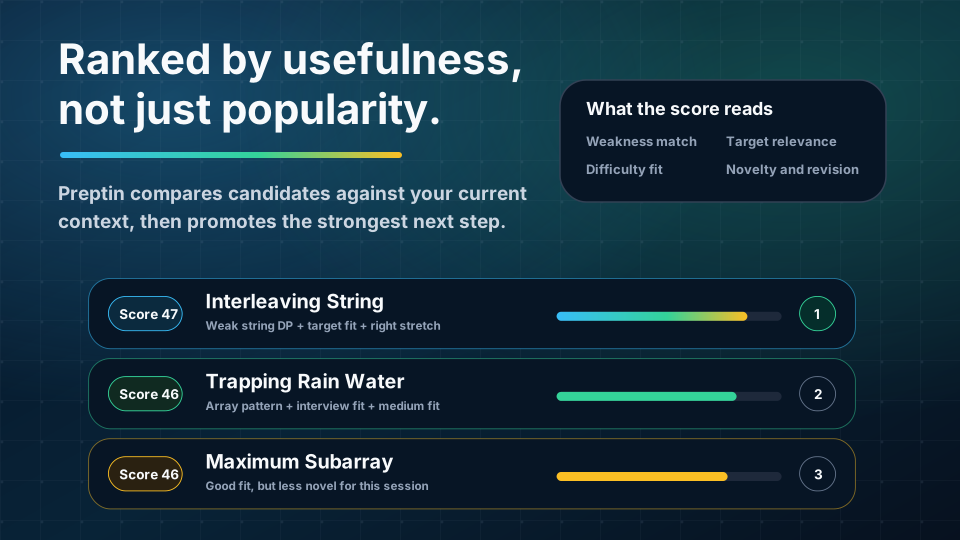
A problem list is static.
A recommendation should be contextual.
A static list can say:
| Static List Logic | Recommendation Logic |
|---|---|
| "This problem is popular." | "This problem matches your current weak area." |
| "This is next in order." | "This is useful based on your recent practice." |
| "This is company-tagged." | "This fits your target and readiness together." |
| "This is a hard problem." | "This is an appropriate stretch for today." |
| "You have not solved it." | "You have not solved it, and it fills a gap." |
That difference matters.
Interview prep is not just about consuming more problems. It is about choosing practice that closes the right gap at the right time.
The Inputs Preptin Uses
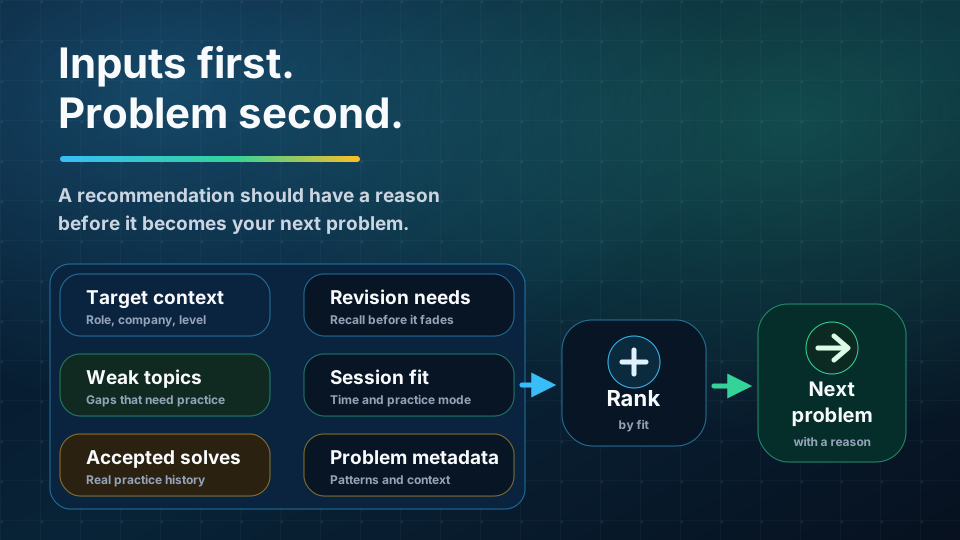
Preptin recommendations become better as the product has more useful context about your prep.
The most important inputs are not mysterious. They come from your setup, your practice history, your revision state, and the problem catalog.
1. Your Target Context
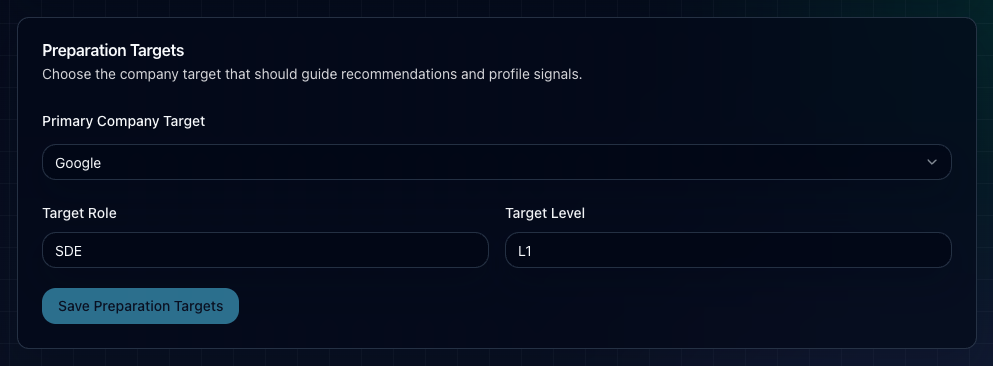
Your preparation target helps Preptin understand what "useful" means.
A campus-placement candidate, a product-company SDE-1 candidate, and a company-specific interview candidate may all need different next problems.
Target context can include:
- Preparation goal.
- Target role or level.
- Target company or company group.
- Company-specific readiness context where available.
- Topics and problem styles that matter for that target.
This does not mean Preptin guarantees company outcomes. It means recommendations can be more relevant than a generic list.
If your target is broad, Preptin can stay broad. If your target is specific, recommendations can give more weight to target-aligned problems.
2. Accepted Submissions
Accepted submissions are one of the strongest pieces of evidence in Preptin.
They show what you actually solved, not just what you opened, bookmarked, or intended to do.
When Preptin sees accepted submissions, it can understand:
- Which topics you practiced.
- Which problems are already solved.
- Which areas have recent evidence.
- Which recommendations should not repeat too soon.
- Which matching recommendation or challenge can be completed.
- Which solved problems may deserve revision later.
This is why submission sync and the browser extension matter. The more accurate your practice history is, the less random the next recommendation feels.
3. Weak Topics and Weak Concepts
A recommendation is most useful when it points at a real gap.
Preptin can use weak-topic and weak-concept inputs to find problems that target areas needing attention.
For example:
- You have low confidence in graph traversal.
- You keep missing binary-search edge cases.
- Your dynamic-programming coverage is thin.
- Your recent solves show a gap in greedy reasoning.
- You have not revised a topic enough for it to feel stable.
In that case, a recommended problem should not simply be "another problem." It should have a job.
The job might be:
- Strengthen a weak topic.
- Revisit a fading pattern.
- Build confidence in a common interview area.
- Stretch you slightly beyond comfortable practice.
- Prepare you for a target-company pattern.
Good recommendations should feel connected to a gap you can understand.
4. Revision Needs
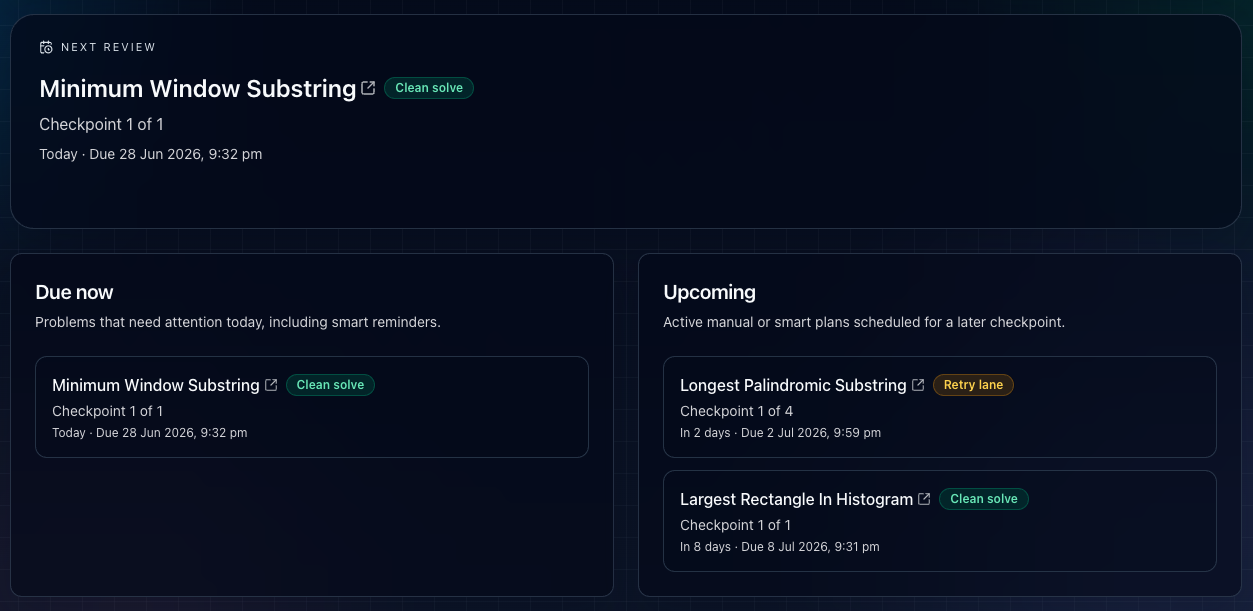
Sometimes the best next problem is not new.
It is an older problem that needs to come back.
Preptin treats revision as part of recommendation context because interview readiness depends on recall. A problem you solved once but cannot reconstruct later is not fully useful yet.
Revision context can help the system notice:
- A topic has due review work.
- A problem has high revision value.
- A solved pattern is likely to fade.
- A retry-like area needs another pass.
- Today may be better spent reviewing before adding more volume.
This matters because candidates often overvalue new solves and undervalue recall.
Recommendations should help you avoid that trap.
5. Difficulty Fit
A useful recommendation should be challenging, but not careless.
If the problem is too easy, it may not move your prep forward. If it is too hard, it may create frustration without enough learning.
Preptin looks for difficulty fit based on your current prep state and the problem's difficulty information.
That can mean:
- An easier problem when you need confidence or a warmup.
- A medium problem when the topic is weak but approachable.
- A harder problem when you are ready for a stretch.
- A revision-first pick when recall matters more than novelty.
The best next problem is not always the most difficult one.
Sometimes the best next problem is the one you are most ready to learn from.
6. Session Fit
Not every prep session is the same.
Some days you have 20 minutes. Some days you have 90. Some days you need a warmup. Some days you want a deep stretch problem.
Preptin can use session-fit details such as estimated solve time and practice mode to make recommendations more practical.
That matters because a recommendation that is theoretically good but impossible for today's session is not actually helpful.
A good system should be able to support different modes:
- Practice when you want a normal next problem.
- Revision when due review matters most.
- Warmup when you need a lighter start.
- Stretch when you are ready for something harder.
- Daily challenge when you want a focused prompt.
The recommendation should fit the work you are trying to do, not just the problem catalog.
7. Novelty and Repetition
Recommendations should not keep pushing the same problem forever.
Preptin considers whether a problem was solved or recommended recently. If a problem is too recent, it may receive a lower priority unless there is a strong revision reason.
This helps reduce two common problems:
- Seeing the same recommendation again and again.
- Practicing a topic so repeatedly that other gaps stay hidden.
Novelty does not mean "always new." It means the recommendation should respect what you have already done.
Sometimes repetition is useful. Revision is built on repetition. But repetition should have a reason.
8. Problem Quality and Interview Value
The problem itself also matters.
Preptin's catalog can include metadata such as:
- Topics.
- Concepts.
- Pattern families.
- Estimated solve time.
- Estimated interview time.
- Learning value.
- Revision value.
- Interview value.
- Company or target relevance.
This metadata helps recommendations avoid treating all problems as equal.
Some problems are better for learning a pattern. Some are better for revision. Some are better interview-style practice. Some are useful only after prerequisites are clear.
The recommendation system can rank problems more responsibly when the catalog has enough structure.
Basic vs Personalized Recommendations
Preptin can show recommendation cards in different levels of personalization.
Free users can see basic recommendation cards. These are useful for getting unstuck, but they are less deeply personalized.
Premium recommendations can use more of the connected prep context, including weakness, target company, readiness, and revision needs.
That difference matters.
| Recommendation Type | What It Means |
|---|---|
| Basic | Useful problem suggestions with limited personalization |
| Personalized | Ranking influenced by weak topics, targets, readiness, revision, and history |
The goal is not to make Free feel useless. Basic recommendations can still help you move. Personalized recommendations are meant to make the next step more specific to your actual prep state.
What Happens When You Accept a Recommendation
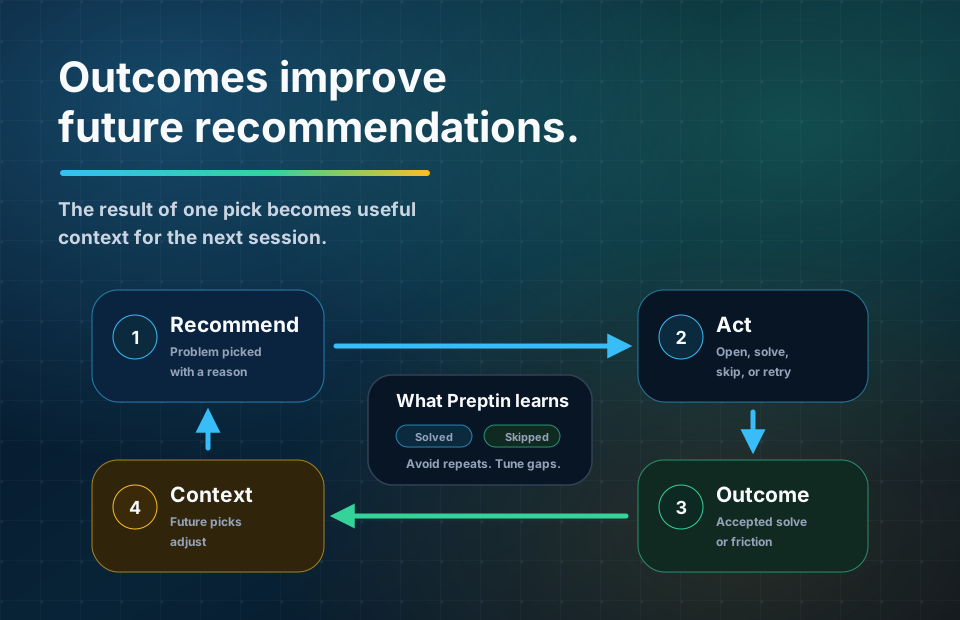
A recommendation is not just a card on the dashboard.
It can become part of the prep loop.
The usual flow looks like this:
- Preptin recommends a problem.
- You open the problem.
- You solve it on Preptin or a supported coding platform.
- An accepted submission syncs where supported.
- Preptin can mark the related recommendation as completed.
- The solve can update activity, readiness, revision, challenges, and future recommendations.
That last step is important.
Recommendations should learn from outcomes. If a recommended problem becomes an accepted solve, that is evidence. If you skip, abandon, or struggle with a recommendation, that can also be useful context over time.
The recommendation is the start of a feedback loop, not the end of it.
Why a Recommendation Might Feel Wrong
No recommendation system is perfect.
Sometimes a pick may feel off. That can happen for several reasons:
- Your setup is incomplete.
- Your target context is too broad or outdated.
- Your submission history is missing recent solves.
- A platform is not connected or verified.
- The browser extension has not captured enough context yet.
- The problem catalog is still missing richer metadata.
- You recently practiced something outside Preptin.
- You want a different session mode than the one being ranked.
When a recommendation feels wrong, do not treat it as a command.
Treat it as a suggestion with context.
You can still choose a sheet, start Prep Challenge, review due problems, work on a weak topic manually, or solve a problem your interviewer specifically asked you to prepare.
Preptin works best when recommendations support your judgment, not replace it.
How to Get Better Recommendations
If you want recommendations to feel sharper, improve the inputs they depend on.
Start with the basics:
- Complete your setup profile.
- Add your target role or company context.
- Connect the platforms where you actually solve.
- Install and enable the browser extension for supported flows.
- Verify platform accounts where Preptin asks for verification.
- Sync accepted submissions.
- Use revision instead of only solving new problems.
- Keep solving enough problems for weak-topic context to become meaningful.
You do not need to do all of this perfectly on day one.
But the principle is simple: better input produces better guidance.
How to Use a Recommended Problem
The best way to use a recommendation is to ask why it might be here.
Before solving, check:
- What topic does it test?
- Is it new practice or revision-like practice?
- Does it match a target company or role?
- Is the difficulty appropriate for today?
- Does it close a weak area?
- Do you have enough time for it now?
Then solve actively:
- Try the problem without immediately reading the solution.
- Write the pattern in your own words.
- Notice where you got stuck.
- Submit and sync the accepted solve where supported.
- Add revision if the pattern felt shaky.
- Let the outcome inform the next recommendation.
A recommended problem is most valuable when you turn it into evidence.
Recommendations vs Sheets vs Challenges
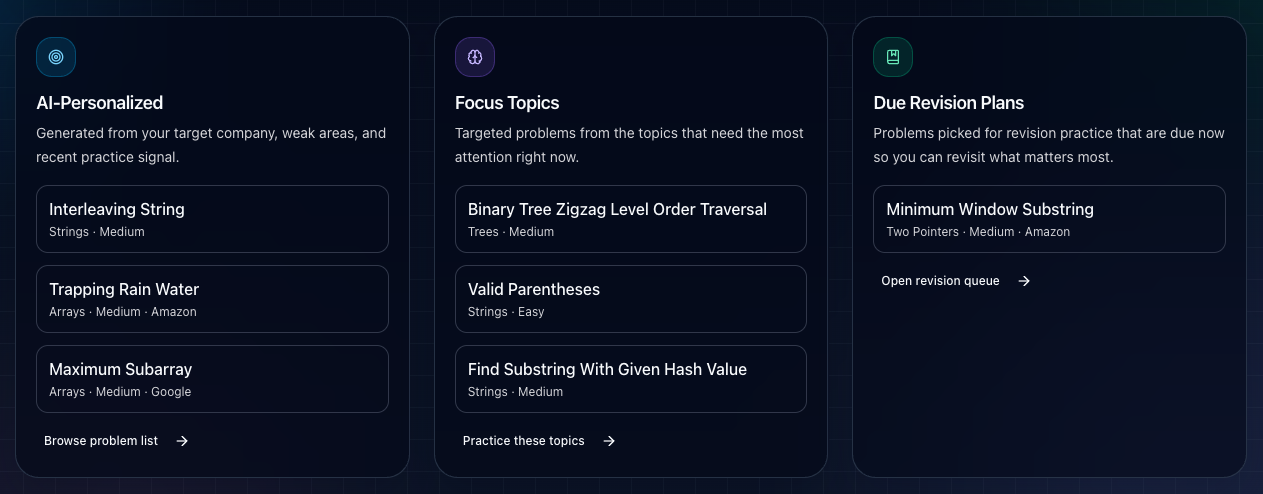
Recommendations are not meant to replace every other Preptin surface.
They are one route to the next useful action.
Interview Prep Sheets are useful when you want structured role or company paths. Prep Challenge is useful when you want a focused assignment. Daily Challenge can help with consistency. Revision Queue helps bring old solves back. Weak-topic context can help you choose a topic manually.
Recommendations sit beside those surfaces.
They are especially useful when you are asking:
- "What should I solve now?"
- "What fills my current gap?"
- "What is a good next step from my real practice history?"
- "What should I do when I do not want to browse a long list?"
If you already know exactly what to do, follow that plan. If you are stuck choosing, use the recommendation.
What Recommendations Are Not
It is worth being clear about expectations.
Preptin recommendations are not:
- A guarantee of interview success.
- A claim that one problem can fix a topic.
- A replacement for learning fundamentals.
- A promise that every company-tagged problem will appear.
- A reason to ignore revision.
- A reason to avoid structured prep paths.
They are a prioritization tool.
They help turn scattered context into a more useful next move.
A Practical Example
Suppose you are preparing for product-company SDE-1 interviews.
Your recent submissions show several array and hashing solves. Your graph coverage is thin. Your target context values graph traversal and shortest-path basics. Your dashboard also shows revision due in older BFS-style problems.
A generic list might recommend a popular hard dynamic-programming problem because it is famous.
Preptin may instead recommend a medium graph traversal problem.
That recommendation has a clearer reason:
- It matches a weak topic.
- It supports the target context.
- It is not too far beyond your current readiness.
- It connects to revision needs.
- It gives useful interview value.
That is a better next step than chasing difficulty for its own sake.
Frequently Asked Questions
Does AI choose every problem for me?
No. Recommendations suggest useful next problems, but you remain in control. You can choose a sheet, challenge, weak topic, revision item, or any problem manually.
Why do I see basic recommendations?
Basic recommendations appear when the product has limited personalized ranking available for your plan or state. Premium can use more inputs such as weakness, target company, readiness, and revision context.
Why are there no recommendations yet?
Preptin may need more context. Complete setup, connect platforms, sync accepted submissions, and keep solving. Sparse practice history can make the recommendation feed quieter.
Can recommendations use my accepted submissions?
Yes. Accepted submissions help Preptin understand what you solved, avoid unnecessary repeats, complete matching recommendation events, and improve future guidance.
Do recommendations depend only on Interview Prep Sheets?
No. Sheets are one useful prep path, but recommendations can also use weak topics, recent submissions, revision needs, target context, problem metadata, and challenge-style practice history.
Can a recommendation be wrong?
Yes. Recommendations are guidance, not commands. If a pick does not fit your session, skip it and choose a better action. The system should support your prep judgment.
Does this guarantee interview readiness?
No. Readiness and recommendations are guidance, not guarantees. They can help you practice more intentionally, but interviews still depend on many factors, including communication, fundamentals, problem variation, and day-of performance.
Final Takeaway
AI recommendations in Preptin are not about making prep feel mysterious.
They are about making the next step less random.
When Preptin has your setup context, accepted submissions, weak-topic history, revision state, and target direction, it can recommend problems with a clearer reason behind them.
The best recommendation is not simply the hardest problem or the most popular problem.
It is the problem that helps your next session close the right gap.